Your data stays on your side: how PortWave Enterprise is secured inside your infrastructure

For a bunker trader or a shipping agency, the sensitive part of the business is not where vessels are. Vessel positions and port calls are market data, and competitors can buy the same feeds. What is sensitive is everything around that data: who your customers are, which vessels you have supplied, what you quoted, which deals you lost, how much credit you extend, and which leads your team is working this week.
PortWave Enterprise is built around that distinction. In the enterprise model, PortWave is not a cloud service you send data to. It is deployed inside your own infrastructure and integrated with your own systems. The only thing it takes from outside is market data from the PortWave Core API. This post explains how that works technically, and what your own team can verify.
The architecture at a glance
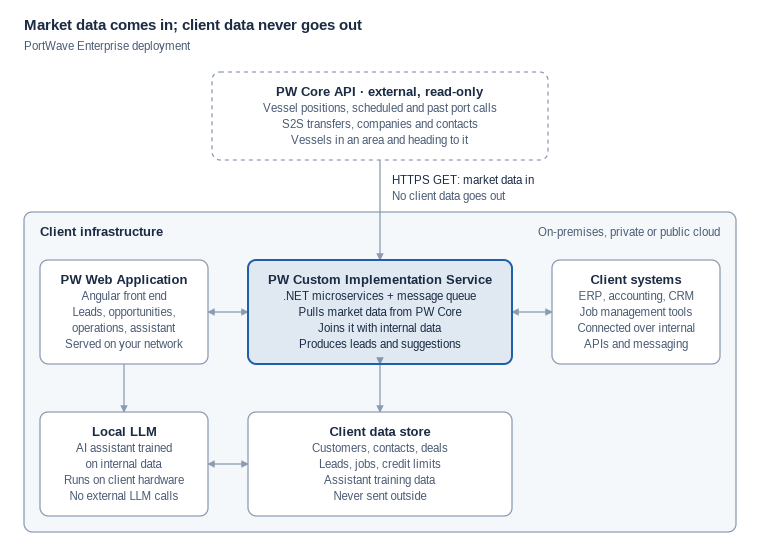
There are two zones. The PW Core API sits outside and only answers requests for market data. Everything else runs inside the client’s perimeter: the application, the implementation service, the language model and all client data.
What runs inside your infrastructure
Everything that touches your commercial data runs inside your perimeter:
- PW Custom Implementation Service. The backend: .NET microservices that communicate over a message queue. It pulls market data from the Core API, combines it with your internal data, and produces lead suggestions, opportunity context and operations data. It is custom because each enterprise implementation is fitted to the client’s systems and workflows, not shipped as a fixed package.
- PW Web Application. The Angular front end used by your traders, agents and operations staff. It is served from your network, behind your access controls.
- Client data store. The databases that hold customers, contacts, opportunities, leads, jobs, credit limits and exposure, plus the history the AI assistant learns from. It sits in your environment and follows your backup, encryption and retention policies.
- Local LLM and AI assistant. The language model and the assistant built on it, covered in detail below.
- Integrations with your existing systems. ERP, accounting, CRM and job management tools connect to the implementation service through internal APIs and messaging. Integration traffic stays inside the network.
What comes from outside: the PW Core API
The Core API is the only external dependency, and it provides market data only:
- vessel positions
- scheduled port calls
- port call history
- ship-to-ship (S2S) transfers
- companies, and contacts at those companies
- vessels inside a defined area
- vessels expected to arrive in an area
The relationship goes one way. The implementation service sends GET requests and receives data back. It does not write to the Core API or push records to it, and no customer, deal, lead or internal record is ever part of a request. A request carries only the parameters needed to fetch market data, such as a vessel identifier, a port, an area of interest or a time window.
It is worth being precise about that last point. The parameters of a query (which area, which vessel) are visible to the API that answers it. What never travels is the context that gives them commercial meaning: who the customer is, what was quoted, whether the deal was won.
Enforcing the boundary at network level
You do not have to take the data flow on trust. The deployment is designed so your own network controls can enforce it:
- Outbound only. The Core API never opens a connection into your network, so no inbound firewall rules are needed for it.
- One egress destination. The only external destination the platform needs is the Core API endpoint, over HTTPS. Your firewall or egress proxy can allowlist that one host and block everything else for the PortWave workloads.
- Authenticated and encrypted. Calls are authenticated with API credentials issued for your implementation and encrypted in transit with TLS.
- Auditable. Because all outbound traffic goes to one endpoint, your proxy logs give your security team a complete record of what was requested and when.
A local LLM that keeps what it learns
Many AI products send prompts, and whatever data is in them, to a model hosted by a third party. In the enterprise model, that path does not exist.
- The model runs on your hardware. The model weights are deployed inside your infrastructure, and inference runs on your own servers, on-premises or in your cloud tenancy. There are no calls to external LLM APIs.
- Trained on your internal data. The assistant is trained on your own data, such as customer history, past jobs and deals, and whatever other internal sources your team chooses to include. It answers in the context of your business, not just general market knowledge. The training data, the resulting model and any indexes built over your documents all stay in your environment.
- Nothing leaves through the model. The LLM has no route to the outside world, and its network policy can deny all egress. It reads from your internal data store and answers users inside your network. Prompts, answers and what the model has learned are not sent anywhere.
- Reached through the application. Users access the assistant through the PW Web Application, behind the same sign-in and access controls as the rest of the platform.
Any infrastructure
PortWave Enterprise is infrastructure-agnostic. It can run in your own data centre, in a private cloud, or in your tenancy on Azure, AWS, Google Cloud or another provider. The platform is made of standard components (.NET microservices, a message queue, an Angular web front end and a locally hosted LLM), and the deployment is not tied to any one cloud vendor.
During implementation, the platform is fitted to the standards you already run: networking and segmentation, identity, monitoring, backup and encryption. Hardware for the local LLM is sized to your environment and expected usage.
Who controls what
| Component | Where it runs | What it holds | Controlled by |
|---|---|---|---|
| PW Core API | PortWave, external | Market data: vessels, port calls, S2S, companies, contacts | PortWave |
| PW Custom Implementation Service | Client infrastructure | Market data retrieved from Core, internal data in processing | Client |
| PW Web Application | Client infrastructure | User sessions and views | Client |
| Client data store | Client infrastructure | Customers, contacts, deals, leads, jobs, credit | Client |
| Local LLM and AI assistant | Client infrastructure | Model, training data, indexes | Client |
In short
Market data comes in. Nothing goes out. Your customers, deals and leads, and the model trained on them, stay where they already are: inside your infrastructure, under your controls.
For smaller teams, PortWave also runs as a cloud SaaS. The enterprise model is for organisations that want PortWave’s market intelligence working directly alongside their own systems, without their commercial data ever leaving their infrastructure.