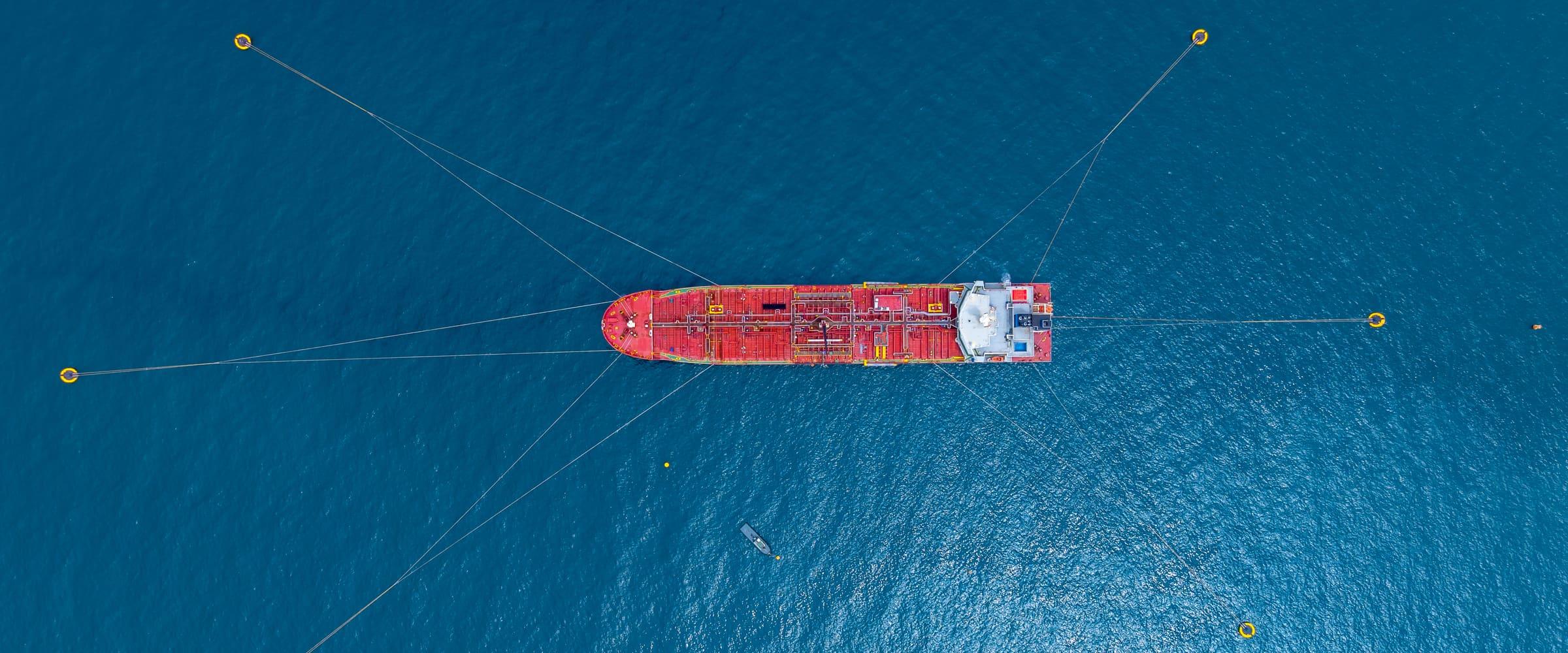
Estimating Remaining On Board (ROB) from AIS: What Works and What Doesn't
If you could know one thing about a vessel before calling its operator, it would probably be how much fuel is left in its tanks. Remaining on board, or ROB, decides whether a ship needs to bunker at the next port, can wait for a cheaper one, or doesn’t need you at all this voyage.
The crew knows. The operator knows. You don’t, and nobody outside the ship can read it off a screen. What you can do is estimate it. This post walks through how that estimate is built from AIS and vessel data, and where it stops being reliable. We’re writing it partly because “AI-powered fuel prediction” gets thrown around a lot, and it helps to see what’s actually underneath.
What AIS gives you, and what it doesn’t
AIS is the stream of position reports ships broadcast. From it you get position, speed over ground, heading, and a few fields the crew types in by hand: destination, ETA and draught.
That’s more useful than it sounds. Positions over time give you distance sailed and time spent at sea versus at anchor or alongside. Speed tells you a lot about consumption. Draught, compared with the ship’s design draught, hints at whether it’s laden or in ballast.
What AIS doesn’t give you is anything about the engine or the tanks. No fuel levels, no engine load, no consumption. And the hand-typed fields are only as good as the person typing them. Destinations like “FOR ORDERS”, or a port code with a typo, are common.
Building the estimate
The basic idea is bookkeeping. Start from a known point, subtract what the ship burns as it goes, add what it takes on when it bunkers.
The burn part comes from the vessel’s particulars: type, size, engine, design speed. Those give a baseline daily consumption at service speed. Then you adjust for how the ship is actually being sailed.
Speed is the big one. As a rough rule, fuel burn per day rises with something close to the cube of speed, so a ship slowing from 14 to 12 knots burns noticeably less per day, and less per mile too. Slow steaming is exactly why estimates based on design speed tend to come out too high.
Laden or ballast matters as well, since a deeper ship needs more power for the same speed. Time in port isn’t free either; auxiliary engines and boilers keep running alongside and at anchor.
Emission control areas add a twist. Inside an ECA a ship has to burn compliant low-sulphur fuel or use a scrubber, so you may need to track two fuel types rather than one.
The starting point problem
Here’s where most estimates quietly go wrong. Bookkeeping needs an opening balance, and for ROB the opening balance is the last time the ship took fuel.
Sometimes you can see it. A call at a known bunkering hub, with a stay long enough to bunker. A ship-to-ship transfer, spotted because two vessels sat together at low speed and one of them is a known bunker tanker. And if your company supplied that stem, you have the BDN with the exact quantity.
Often, though, you’re assuming. The ship called at a port where it might have bunkered. It disappeared from coverage for a few days. It was in the Gulf, where GPS interference makes positions jump around. In those cases the estimate rests on a guess, and everything that follows inherits it.
That’s why we think the honest output isn’t a single number. It’s a range, plus a statement of how much the starting point can be trusted.
How wrong can it be?
Fairly wrong, and it’s better to say so. Even with a good starting point, small errors in consumption add up day after day. A ship that bunkered three days ago is easy. A ship whose last known bunkering was seven weeks ago, through two ECA passages and a port stay nobody can explain, is not.
We work with ROB as a band of roughly plus or minus 20 to 30 percent, and wider when the starting point was assumed. That sounds disappointing until you remember what the estimate is for. You’re not filling in a BDN. You’re deciding whether a ship is worth a call this week. For that, “probably needs fuel in the next ten days, and we’re fairly sure” is useful. So is “might need fuel soon, but we’re guessing.”
Those are really two separate measures: urgency (how soon) and confidence (how sure). Keeping them apart is the single most useful thing you can do with a ROB estimate, and it’s the same point we made in our post on lead prioritization.
Checking against reality
The best way to improve an estimate is to compare it with what actually happened. For bunker sellers, the best record of what happened is the BDN archive: date, port, vessel and quantity delivered.
Fifty or a hundred past deliveries are enough to see whether your consumption assumptions run high or low for certain ship types, and whether the bunkering events you detected line up with real ones. Enquiry history helps too. A ship that asked for 800 tonnes is telling you something about its tanks.
Where PortWave comes in
PortWave estimates ROB from AIS movements, vessel particulars and detected port calls and ship-to-ship transfers, and shows urgency and confidence separately, so a trader can see how soon a ship is likely to need fuel and how much weight to put on that. If you’d like to see it on ships you know, book a demo.